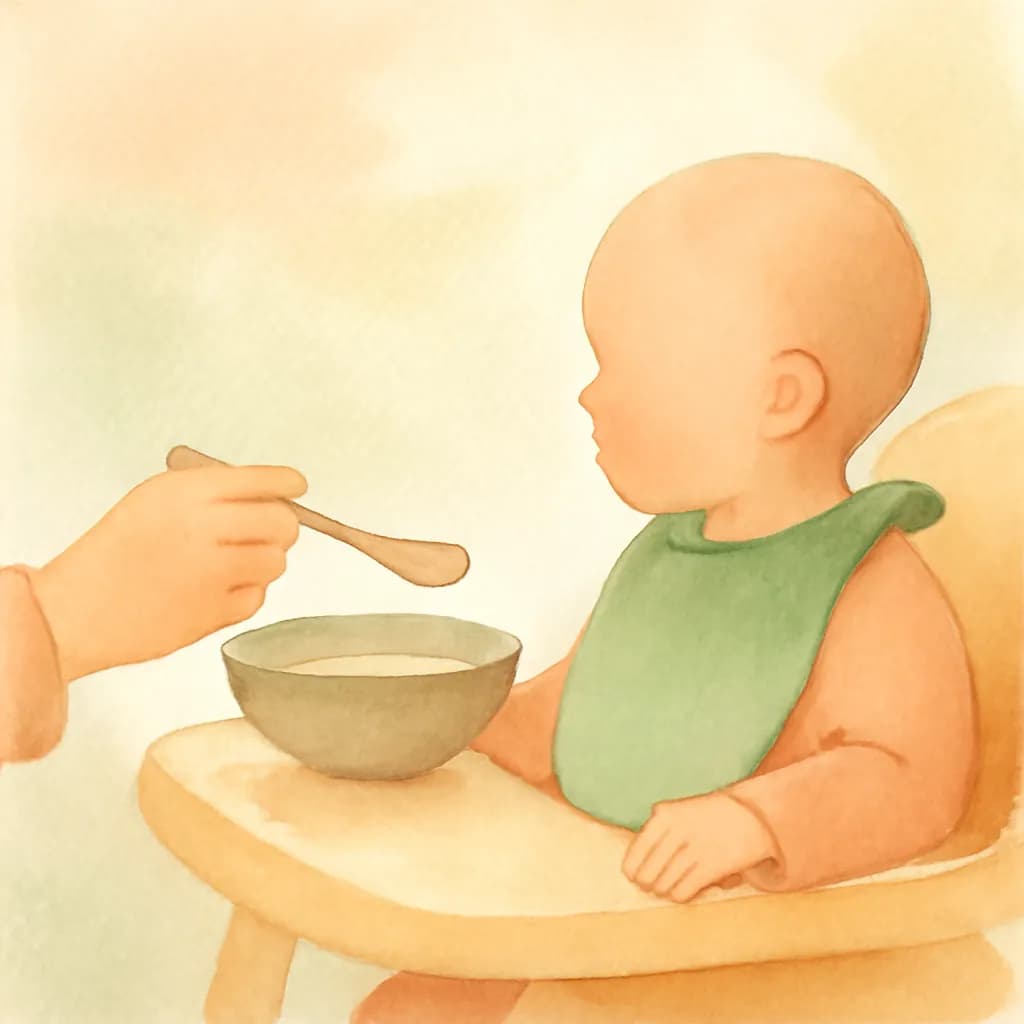
When are babies ready?
Most healthy, term babies are ready for solids around 6 months. Readiness shows up as a cluster of physical and developmental skills, not just an age. Some babies show signs at 5.5 months; others need until 6.5 or 7 months. Both are normal.
Looking for the readiness signs is more reliable than the calendar date. Babies who start before they're ready often refuse, gag, or have trouble swallowing. Waiting until the signs are clearly there makes the start much smoother.
The 5 readiness signs
- 1) Sitting with minimal support: baby can stay upright in a high chair without slumping. This keeps the airway in the right position for safe swallowing.
- 2) Good head and neck control: baby holds their head steady and can turn it side to side. Wobbly head control means swallowing isn't safe yet.
- 3) Interest in food: baby watches you eat, leans toward food, opens their mouth, and looks excited at mealtimes. Curiosity is a strong readiness signal.
- 4) Reaches for food and brings it to mouth: deliberately picks things up and brings them toward their mouth. This shows the hand-eye-mouth coordination needed for self-feeding.
- 5) Lost tongue-thrust reflex: food no longer gets pushed straight back out of the mouth. This reflex protects young babies but fades around 4-6 months when the body is ready for solids.
When to talk to your pediatrician
- No readiness signs at all by 7 months - especially if multiple signs are absent.
- Poor head control past 6 months: head wobbles, can't be held steady.
- Cannot sit upright with support past 6-7 months.
- Strong tongue-thrust reflex still present at 7+ months.
- Premature baby - readiness should be assessed using corrected age, not birth age.
- Concerns about overall developmental progress (gross motor, oral motor delays).
How to use the readiness checklist
Check each sign carefully
Go through the 5 signs and rate your baby on each: yes, almost, or not yet. You're looking for at least 4 clear yeses, ideally all 5. One sign alone isn't enough.
Observe over a week, not a single day
Babies have off days. Watch for the signs over a week of meals. If they're consistently there, your baby is ready. If only present sometimes, wait another week or two.
Talk to your pediatrician at the 4 or 6 month visit
Pediatricians do readiness assessments at routine visits. Bring up signs you've noticed and ask their opinion. They can also flag any concerns specific to your baby.
Prepare the environment in advance
Once you see signs starting to appear, get ready: high chair, soft bibs, suction-bottom bowl or just the tray, baby spoons, and an open cup for water. Having things ready makes the first meal feel calmer.
Start when 4-5 signs are clearly present
Don't push the start before the signs are there. A baby who isn't ready will refuse, gag, or lose interest fast. A baby who is ready jumps right in within a few meals.
Begin with one meal a day
Start small: one short meal a day, a few teaspoons or 2-3 soft finger food pieces. The first few weeks are practice, not nutrition. Milk still covers all needs.
Re-check signs if you're unsure
If you're 50/50 on any sign, wait a week and re-check. Waiting a week or two when uncertain almost always makes the start smoother. Nothing is lost by holding off briefly.
Frequently asked questions
How many readiness signs does my baby need to show?
Aim for at least 4 of the 5 signs clearly present. Sitting with support and good head control are the non-negotiable safety signs. Interest, reaching, and lost tongue-thrust round out readiness. If only 1-2 signs are present, wait another week or two.
My baby is interested in food but doesn't sit well - is that ready?
Interest alone isn't enough. Without stable sitting and head control, swallowing isn't safe. Wait until your baby can stay upright in a high chair without slumping. In the meantime, you can let them watch family meals and chew on a cold spoon to stay engaged.
Is the tongue-thrust reflex easy to spot?
Yes - try a small spoon of breast milk, formula, or a tiny taste of plain mashed banana. If it gets pushed straight back out with the tongue, the reflex is still there. If your baby moves it around the mouth and seems to swallow, the reflex has faded.
Can readiness signs appear before 6 months?
Some babies show signs around 5.5 months. If 4-5 signs are clearly there before 6 months, talk to your pediatrician. They may give the green light to start a few weeks early. But never start before 4 months.
What if my baby is over 6 months but signs are unclear?
Re-check in 1-2 weeks. Most babies show clear signs by 6.5-7 months. If signs aren't there by 7 months, talk to your pediatrician - this can sometimes signal a developmental issue that benefits from early support.
Should I delay solids if my baby has reflux or other issues?
Don't delay routinely without a pediatrician's input. In some cases (severe reflux, certain medical conditions), timing may shift slightly, but most babies with reflux start solids on the typical schedule. Solids can sometimes even reduce reflux symptoms. Discuss with your pediatrician.
Plan your baby's first foods, with recipes
From the first spoonful onward, get a personalized starting-solids plan with age-matched recipes and the next step always one tap away.
verifiedSources & References
This guide is informed by current guidelines from leading health organizations: